



.jpg)
.jpg)
.jpg)
Tungsten Market Report: March 3, 2026
Author:kangbote Time:2026-03-04 11:58:56
.jpg)
.jpg)
Tungsten Market Report: March 3, 2026
As the Lantern Festival arrives, the tungsten market's hot streak continues. The prevailing market optimism stems from long-term supply constraints driven by policy and sentiment, coupled with tungsten's reinforced status as a strategic critical mineral and increased capital allocation preference, collectively supporting the firm price trend. According to statistics from China Tungsten Online, as of the time of writing, within just the first two months of 2026, the price of major tungsten raw materials has risen by approximately 85%, while the price of tungsten scrap has surged by 120%.
However, the high market sentiment is accompanied by accumulating risks. On March 2, several listed companies in the tungsten industry issued abnormal stock trading fluctuation announcements, warning about the risks associated with the recent rapid stock price increases and reminding investors to be cautious of secondary market trading risks. China Tungsten Online has summarized the main risks as follows:
(1) Macroeconomic Risk. Tungsten products are widely used in the national economy. Cyclical fluctuations in the macroeconomy will directly impact the overall demand from downstream manufacturing, which in turn affects the market demand and price performance of upstream tungsten products. The demand for tungsten products may fluctuate in sync with or amplify economic fluctuations, such as downturns in major economic sectors like infrastructure and real estate, which consume significant amounts of tungsten products.
(2) Discrepancy Between Consensus and Reality in Application Fields. The actual consumption of tungsten raw materials in consensus application areas may differ significantly from market expectations, potentially failing to fully absorb capacity and the short-term price congestion. Especially in fields like aerospace, defense, photovoltaics, and new energy, the application volume may not be as large as subjectively perceived, potentially leading to difficulties in cost transmission.
(3) Industry Policy Adjustment Risk. National regulation of the tungsten industry spans all stages, including mining, smelting, operation, and export. Adjustments to relevant industrial policies will directly impact corporate production, operations, and business activities.
(4) Raw Material Price and Supply Volatility Risk. Companies whose self-supply of raw materials cannot meet production needs face challenges related to price fluctuations and supply chain stability when purchasing externally.
(5) Technology Iteration and Substitution Risk. For example, in the field of photovoltaic diamond wire busbars, there are risks related to the penetration opportunities of tungsten wire versus high-carbon steel wire and the risk of counter-penetration.
(6) Exchange Rate Fluctuation Risk. Fluctuations in the RMB exchange rate will directly impact the exchange gains/losses and overall performance of companies with export businesses.
(7) Credit and Performance Risk. Granting credit lines and payment terms to certain customers carries the risk of bad debts from accounts receivable. Defaults by suppliers or customers, such as failure to deliver or pick up goods as agreed, may trigger a chain reaction, affecting production continuity and performance stability.
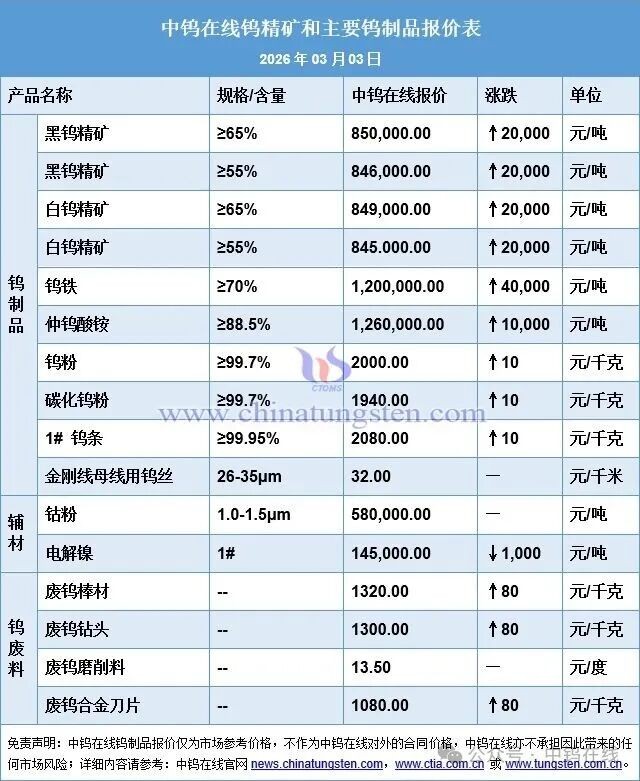
As of the time of writing, the latest prices for major tungsten products are as follows:
65% Black Tungsten Concentrate: ¥850,000 per metric ton (standard), up 84.8% since the beginning of the year.
65% White Tungsten Concentrate: ¥849,000 per metric ton (standard), up 85.0% since the beginning of the year.
Ammonium Paratungstate (APT): ¥1,260,000 per ton, up 88.1% since the beginning of the year.
European APT: $1,890-$1,998 per metric ton unit (equivalent to ¥1,149,000-¥1,214,000 per ton), up 111.3% since the beginning of the year.
Tungsten Powder: ¥2,000 per kilogram, up 85.2% since the beginning of the year.
Tungsten Carbide Powder: ¥1,940 per kilogram, up 86.5% since the beginning of the year.
Cobalt Powder: ¥580 per kilogram, up 11.5% since the beginning of the year.
70% Ferrotungsten: ¥1,200,000 per ton, up 84.6% since the beginning of the year.
European Ferrotungsten: $209-$230 per kg W (equivalent to ¥1,005,000-¥1,054,000 per ton), up 59.6% since the beginning of the year.
Tungsten Scrap (Bar): ¥1,320 per kilogram, up 120.0% since the beginning of the year.
Tungsten Scrap (Drill Bit): ¥1,300 per kilogram, up 124.1% since the beginning of the year.


